Last Updated on January 17, 2026
It usually happens at the front door. Guests arrive, coats come off, and someone asks the question every old-house owner knows too well: “Where should I put my coat?” You glance toward the entry, realize there’s no obvious answer, and suddenly feel like your house is missing something important.
If your old house doesn’t have a coat closet — or has one that’s too small, too shallow, or oddly placed — this isn’t a flaw. It’s a mismatch between how houses used to function and how we live now.
The bad news is that old houses weren’t designed for modern coat collections, daily drop zones, or bulky seasonal layers. The good news? Once you understand what your house was designed to do, you can find coat storage solutions that actually work with your space instead of fighting against it.
This post contains affiliate links, including but not limited to, Amazon Associates. As such, I earn from qualifying purchases. Full disclosure located here.
Why Old Houses Don’t Have Coat Closets
Walk into most older houses built before 1920, and you’ll notice something missing: a coat closet near the front door. Even houses from the 1920s through 1940s often have hall closets that are laughably small by today’s standards—sometimes just 12 inches deep.
This wasn’t an oversight – it’s a testament to history. People simply owned fewer coats. A good wool coat was an investment piece you wore for years, maybe decades. You might have one heavy winter coat, one lighter jacket, and that was it. There were no puffy parkas, fleece layers, or seasonal “jacket wardrobes.”
Social customs were different too. When guests arrived for a formal visit, coats often went upstairs to a bedroom. For quick visits, people kept their coats on. The entry hall was a transitional space for greetings, not a storage zone.
The “coat closet” as we know it—a dedicated built-in space right at the entry—became standard much later, as homes got bigger and our stuff multiplied.
But you’re probably not here for a history lesson, so let’s get to some solutions….
4 Challenges with Coat Storage for Old Houses
I wish our old houses came with a larger closet. But, alas, it isn’t so… So, it’s time to dive into solutions. Most coat storage for old houses problems fall into one of these categories:
- Scenario A: No coat closet at all. Common in older houses built before 1920. There’s simply no hall closets anywhere near your entry. The builder expected you to use furniture or another room.
- Scenario B: A shallow closet. Popular in 1920s-1940s homes, these closets are often 12 inches deep or less. They work fine for lightweight jackets but can’t handle modern winter coats without the door refusing to close.
- Scenario C: A closet in the wrong place. Maybe there’s a closet, but it’s upstairs in the hallway, or at the back of the house, or otherwise nowhere near where people actually enter. Technically you have coat storage, but there’s no easy access. Practically, nobody uses it.
- Scenario D: An awkward retrofitted closet. Someone added a closet at some point, but the door swings the wrong way, or there’s no shelf, or it’s oddly shaped to fit into existing architecture. It exists, but it doesn’t really work.
The solutions that work for Scenario A won’t necessarily help with the other scenarios, so this post isn’t meant to be read from the start to finish. Scroll down to your relevant scenario B.
Solutions for No Coat Closet (Scenario A)
If your old house has no coat closet near the entry, you’re in good company—and you have more options than you think. The key is applying creative ideas and working with how older houses were originally designed: furniture-based storage that’s attractive enough to live in public spaces.
Furniture-Based Solutions
Hall trees and coat stands
A hall tree is the classic old house answer to coat storage, and for good reason. Original antique hall trees with that “old house aesthetic” often include hooks for coats, a mirror, an umbrella stand, and a bench with storage underneath—everything you need in one piece of furniture. Look for something scaled to your entry; a massive oak piece might overwhelm a small space, while a simpler Mission-style or painted Victorian hall tree can work in tighter quarters.

Repurposed armoires
For more coat storage capacity, consider a repurposed armoire positioned in or near your entry. An armoire can hold far more coats than any small closet, and if you choose one with some vintage character, it looks intentional—like it belongs in an old house. This works especially well if you have an entry hall with a bit of width, or if your front door opens into a larger room.
RELATED POST: Where to Find Free Vintage Furniture
Bench + hooks combinations
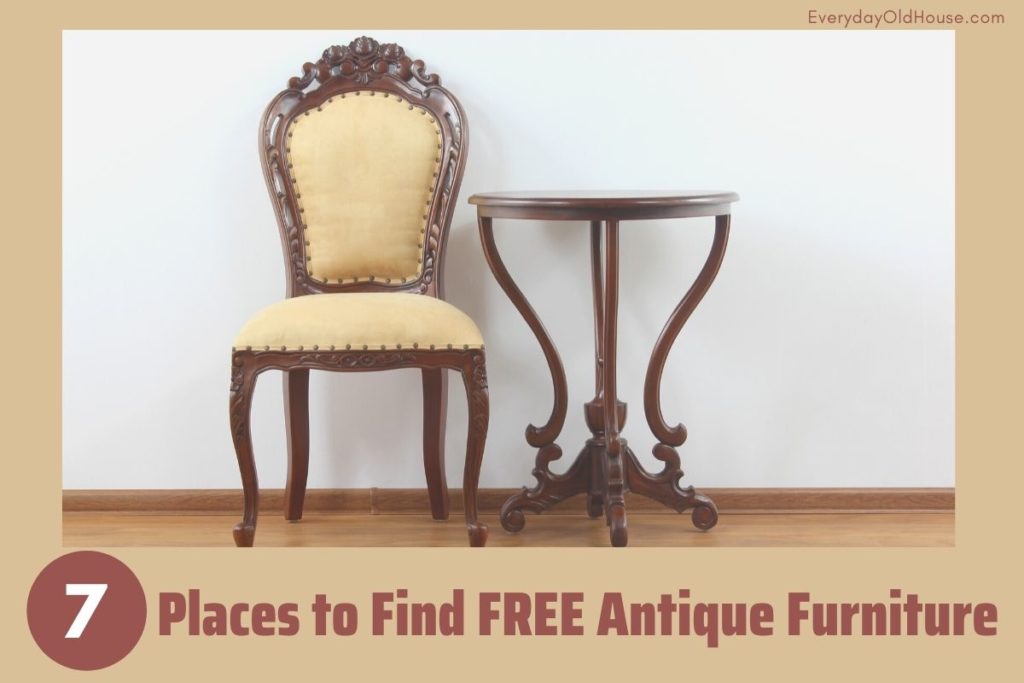
A bench paired with wall hooks creates one of the most functional coat storage systems for old houses. The bench gives you a place to sit while putting on shoes and creates a natural drop zone – a “mini mudroom”. Add hooks or a shelf above, and you’ve solved multiple entry problems at once.
Look for a bench with built-in storage—either cubbies, drawers, or a lift-top seat. Cubbies work beautifully for shoes, and you can add baskets inside them to capture smaller items like scarves, hats, and gloves. A boot tray tucked underneath keeps wet shoes contained during muddy seasons.
For the wall above the bench, you have options (see more below). Double hooks give you twice the hanging capacity—hang a coat on the top hook and a bag on the bottom. Or install a simple shelf above the bench for hats and baskets, with hooks mounted below the shelf for coats. This creates vertical storage that uses your wall space efficiently.
The beauty of this combination is that it scales to your space and can grow as you figure out what you actually need.
Freestanding garment racks
If you don’t have enough floor space for a full hall tree, a freestanding coat rack is the next best thing. Choose one with a wide, stable base and enough hooks to be useful. Position it near the front door or just inside the living room if that’s where guests naturally gather. When styled intentionally, these can work surprisingly well, especially for everyday coats.
Wall-Based Solutions
Coat hooks or hook strips
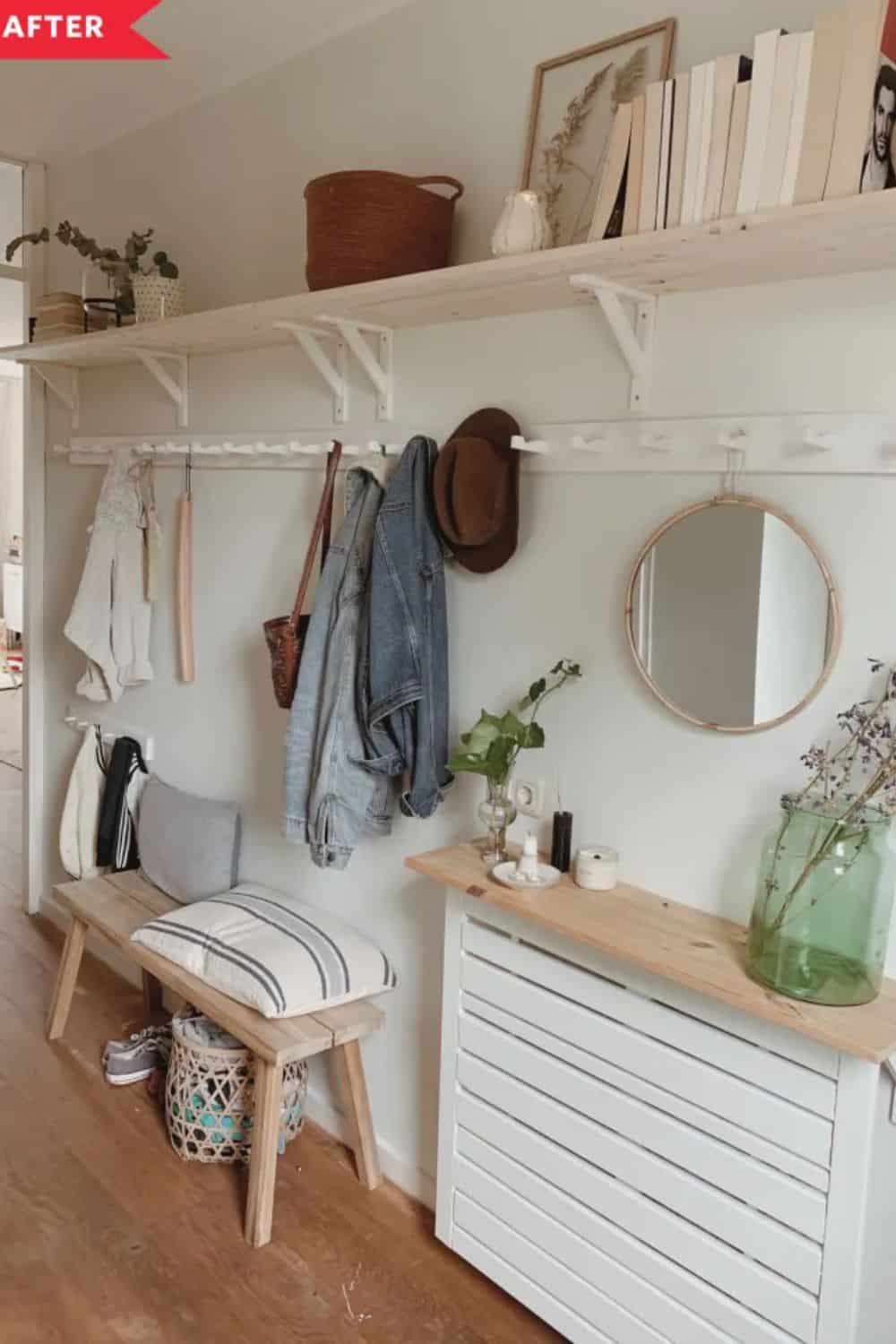
If furniture isn’t an option because your entry is tiny, wall-mounted coat hooks are your friend. The trick is making them look deliberate rather than dorm-room casual. Install a row of sturdy individual hooks or a hook strip along one wall at a comfortable height. Hooks work best when placed thoughtfully—spaced wider apart and mounted at varied heights.
In old houses with plaster walls, make sure you’re hitting a stud or using proper anchors; plaster is less forgiving than drywall if a coat-laden hook pulls free. Consider mounting hooks on trim or door frames when possible for a more secure hold.
Picture rail hooks
In old homes with picture rail molding, you can sometimes use picture rail hooks for coats—a solution that requires zero wall damage. This works best for lighter jackets and bags rather than heavy winter coats, as picture rails weren’t designed to bear much weight. Test with one coat first before loading up multiple hooks.
Shaker pegs
Shaker peg rails are another classic option that suits old house aesthetics. They’re simple, functional, and have been used for centuries. Mount one low enough to be useful (about 5 feet high) and use it for coats, bags, and hats. The angled design of Shaker pegs helps coats stay put better than straight hooks, and you can find them in various wood finishes to match your existing trim.
Borrowing Space from Adjacent Rooms
Sometimes the answer isn’t in the entry at all. If your front door opens directly into the living room or parlor, consider designating a corner of that room as your coat drop zone. A coat rack tucked beside a chair, or a few hooks on the wall near the door, can work beautifully—especially if the rest of your living room has vintage charm.
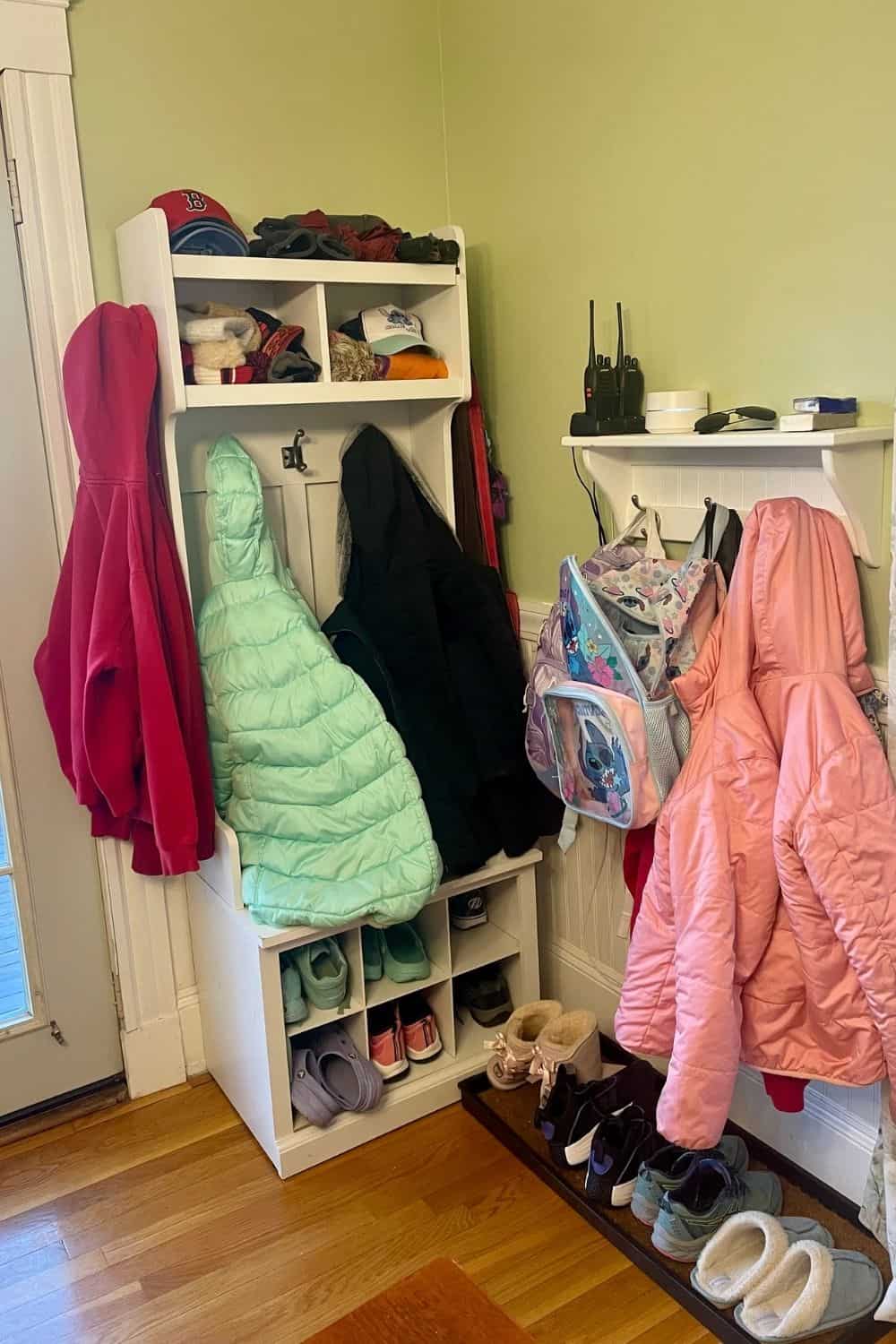
If you have a back hall, mudroom area, or side entry that gets used more often than your formal front door, lean into that. Create the coat storage where people actually come and go, even if it’s not the “proper” entry. For example, we have a coat closet at the entryway to our front door. However, we rarely go in and out of that door. We created a space at either side of our back door that suits our family of five’s needs. (Not the neatest photos – we aren’t an IG-style family – but it works!)

For guest coats during parties, remember that your grandparents had a solution: the bedroom. Designating an upstairs bedroom for coat piling during gatherings is perfectly reasonable and historically accurate.
Solutions for Shallow or Awkward Closets (Scenarios B, C, D)
If you have a coat closet that technically exists but doesn’t work well (usually not enough space), don’t give up on it entirely—at least not yet. Sometimes a few strategic changes can create more available space and make a small coat closet far more functional.
Switch to Slimline Hangers
The biggest enemy of a shallow closet is bulky hangers. Switch to slim velvet hangers or thin wooden hangers to immediately gain a few precious inches. For puffy winter coats, this might mean the difference between the door closing or not. Velvet hangers also grip fabric better, so coats don’t slip off and pile up on the closet floor. Here’s my favorite slim hanger.
Rethink Your Rod Strategy
Single vs. double rods should be chosen based on coat length—not default closet rules. If you only hang shorter jackets and blazers, a double clothing rod system can double your hanging capacity in a shallow closet. But if you need space for full-length coats, keep the single closet rod and don’t force a system that doesn’t match what you actually wear.
When I first wrote this post I envisioned the double rods to be above and below each other. But I found this idea from Danielle Moss that used rods side by side. My point here is to think outside the box with a small or awkwardly sized closet. You never know what might work.
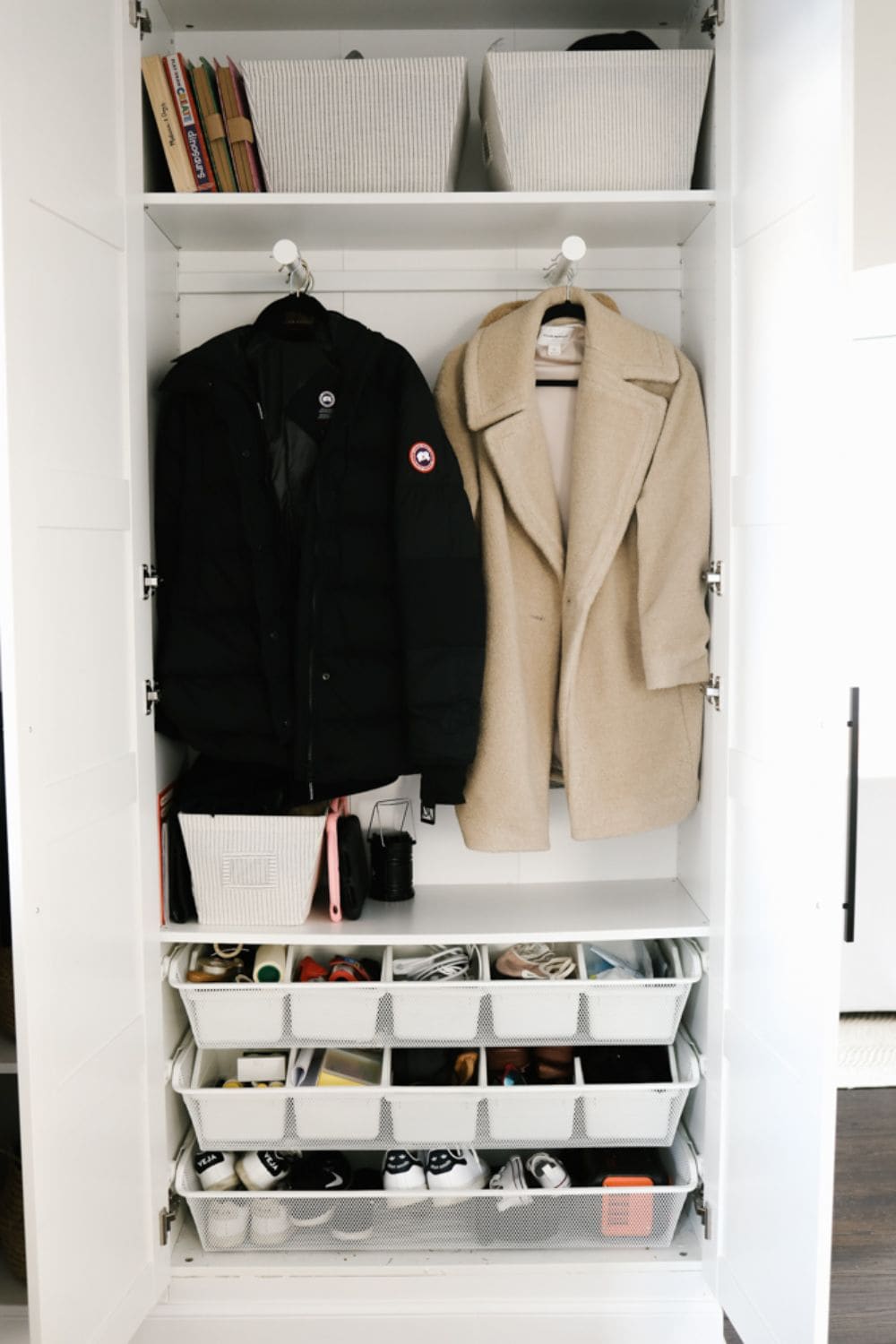
Use Over-the-Door Organizers Wisely
Over-the-door organizers can work in old houses if you check the door thickness first—many older doors are thicker than modern hollow-core doors, so standard organizers may not fit. Use over-door hooks or pockets for accessories like scarves, gloves, and hats rather than trying to cram them onto a shelf. This keeps small items from getting lost in the depths of the closet.
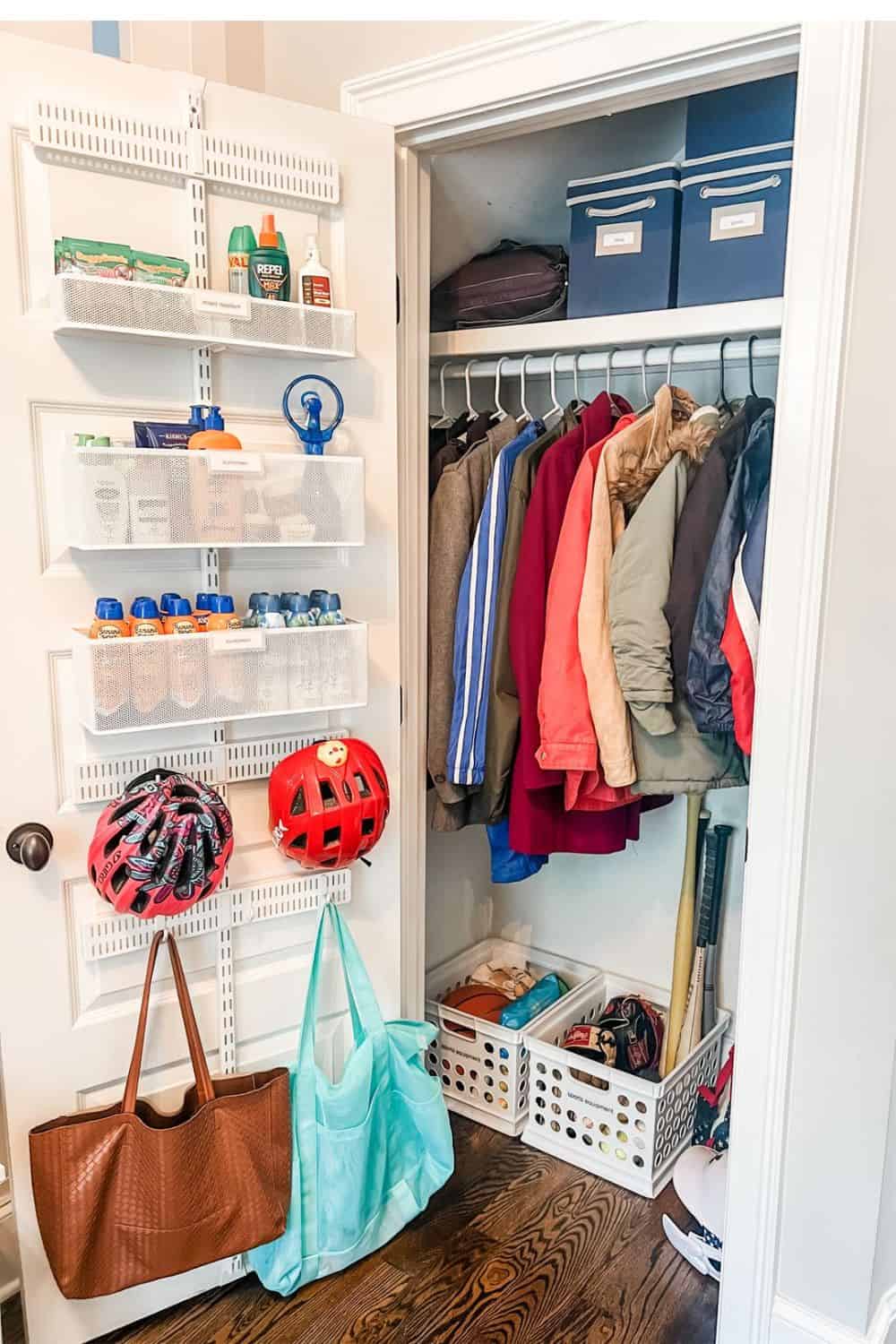
Rotate Seasonally
Consider whether you really need everything in that closet. If you’re trying to fit four people’s coats plus guests’ coats plus last season’s jackets, no small coat closet will ever be enough. Keep only current-season, frequently-used coats at the front door. Everything else can live in a bedroom closet or under-bed storage plastic bins upstairs (or be decluttered and donated).
Use Baskets on the Floor
If your closet floor has sufficient floor splace, use a boot tray, shallow basket or small shoe rack for shoes and boots. Baskets instead of fixed shelves make shallow spaces more usable and flexible—you can pull them out to see what’s inside rather than digging through a dark closet. This keeps the closet floor from becoming a chaotic mess and makes the limited space feel more organized.
When to Repurpose a Bad Closet
Sometimes a closet is so poorly located with no easy access or awkwardly designed that you’re better off using it for something else entirely. That weird narrow closet at the back of the house? Maybe it becomes storage space for cleaning supplies or seasonal decor, and you invest in a good coat rack near the actual entry instead. Don’t feel obligated to use a closet space for its “intended” purpose if that purpose doesn’t match reality.
The Guest Coat Question
Okay – so handled how to deal with maximizing all the available space in older houses with no or small hall closets. But what do you do with hosting a dinner party, and six guests show up in winter coats. Where do the coats go?
The traditional old house solution is simple: the bedroom. Designate an upstairs bedroom (or a bed in a guest room) as the coat room for the evening. This is what people did for generations, and it works. Guests know their coats are safe, and your entry stays clear.
If stairs are an issue or you’d rather keep coats on the main floor, a temporary solution can work beautifully. Set up a freestanding garment rack in an out-of-the-way corner for the evening—maybe in the dining room if you’re eating in the kitchen, or in a back hallway. After the party, it folds up and disappears.
For smaller gatherings, a nearby chair or bench can become temporary coat storage space. Drape coats over the back of a dining room chair or stack them neatly on a hall bench. It’s not a permanent system, but it handles the overflow when you need it.
The key is having a plan before guests arrive, so you’re not frantically improvising when the doorbell rings.
When (Maybe) to Add a Closet or Mudroom
I’m not anti-renovation. Sometimes adding a coat closet or creating a mudroom-style drop zone genuinely improves how an old house functions, especially for families with young kids who need a daily system for coats, backpacks, and shoes.
Adding a new closet makes sense when you have a back entry or side door that’s underutilized, and there’s dead space you can convert without disrupting the flow of the house. A simple closet or even a wall of hooks and cubbies in a back hallway can create the functional drop zone that old homes weren’t built to provide.
It also makes sense if you have awkward space under stairs or in a wide hallway that’s just… there. Sometimes a thoughtful built-in can make closet space work harder without changing the character of the house.
But adding a new closet doesn’t make sense when it would compromise the original layout, chop up a gracious entry hall, or block beautiful architectural details. If you’d have to lose original woodwork, narrow a hallway, or create an awkward bottleneck, it’s not worth it.
Before you commit to construction, live with furniture-based solutions for a season. You might find that a hall tree and a basket for shoes solves 90% of your problem—and costs a fraction of building a closet.

Wrapping Up: Your House Isn’t Broken
The frustration you feel about coat storage in your old house is real. Trust me, I feel it. But it’s not because your house is poorly designed. It’s because we’re trying to use closet space built for one set of expectations with an entirely different lifestyle in a past time period.
The best coat storage solution isn’t the one that looks like a magazine spread from interior designers or mimics what a new house would have. It’s the one that works with your house’s architecture and your actual daily life—whether that’s a beautiful antique armoire, a row of hooks in the back hall, or a simple coat rack near the front door.
Your old house solved the coat problem a different way. Once you understand that, you can stop fighting the house and start working with it.
Related Posts You’ll Love
Want to be the first to know about new posts? Be sure to follow me on Pinterest, Facebook, Instagram or Twitter of even Etsy! Or better yet… Subscribe below!
My monthly (admittedly sometimes more, sometimes less….) emails are like receiving a unexpected letter from an old friend WITHOUT needing to put on your slippers and walk out to your mailbox…. See? I got ya, my friend!)
[Note: My posts are proudly connected to these amazing link parties full of DIY ideas and inspiration!]